

The Blue Flower
A botanical story.

Dear Friends,
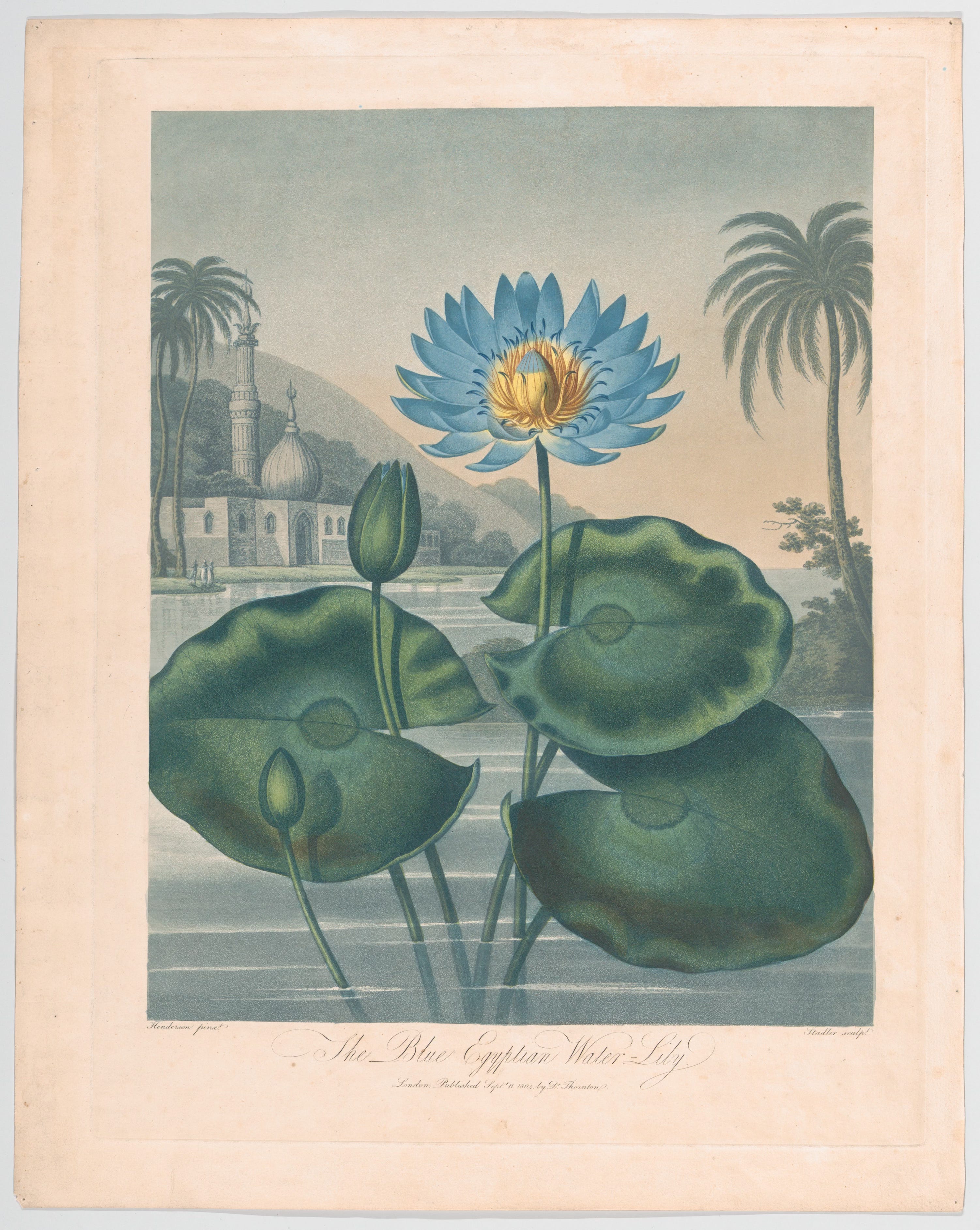
This botanical tale began in reading Penelope Fitzgerald’s short, strange, brilliant novel, The Blue Flower.
The Blue Flower follows the early adulthood of the German poet-philosopher Novalis during the years 1790-1797, centering on his romance with Sophie von Kühn who was twelve at the time of their meeting.
— Sal
The Blue Flower
In the case of many remedies and treatments it takes some time to know what the effects will be. Pessimism can set in, or unwarranted optimism. Further, you may apply a single color like blue which is effective for the upper reaches but does nothing to help the lower.
Two flower arrangers were preparing for a large event. They dressed alike: black jeans, black t-shirts, and they both had dark hair. One was older, one younger. The younger brought the flowers in from the street, where presumably a delivery truck had carried them from the floral district. Back and forth the younger went with huge conical bundles wrapped in brown paper. There were boxes as well, shipped by air from growing countries. He filled buckets and tubs of water in the sink and moved them into the cool oblivion of the back room. Soon everything would seem to be just as it had been while an almost hysterical abundance accumulated unseen.
This was just one stage of things. There were others prior, such as the contract, the growing, the shipping, the ordering. The arranging would come soon, of course, and the event itself. The nature of flowers dictate the timing. Or we could think of the florist: where he woke this morning, and what time, and who with. What work would he be doing ten years from now?
As he began stripping long stems of their excess leaves the younger florist moved with a simple competence, an ease that suggested his tasks were acceptable to him. It was peony season, and the flowers he handled were almost at the peak of their blooming. They didn’t need much preparation, a quick cut on each stem and a binding with brown twine.
If we gave the florist a name, if we followed his trajectory of desire and fate, we would be compounding one sort of medicine. In another type of story, something supernatural would intervene, perhaps in the form of the large black-glass vase now being polished by the older florist. Or, as has become commonplace, we could slip back into the mind of the observer who is still trying to throw off the remnants of a dream from the night before. (The final scene of the dream took place in the dark; every character in the scene was familiar to the dreamer but also strange).
Aristotle says, “Tragedy is the imitation of an action; and an action implies personal agents, who necessarily possess certain distinctive qualities both of character and thought….Hence, the Plot is the imitation of the action—for by plot I here mean the arrangement of the incidents.”
Happily, the dreaming observer has appreciated their time with Aristotle. A myth can be made of the most mundane components. A bus, say, linking two towns. A convivial meeting with disquieting undertones. A desire that is almost fulfilled.
While eating from a plastic bowl with a plastic spoon the older florist has composed a plenitude expressing itself improbably upwards from the black glass. It is a convention of narrative that the blowsiness of dark peonies be set off by stems narrow, green-white, and gently curving, like that of the foxtail lily. Thus, in the pursuit of beauty, beauty is forever lost.
Here’s the question: how much of the drug do you need? How much of the drug does your doctor think you need? The protocol can be confusing at first and your age is different depending on what city you are in. How much can be retrieved? How much will disintegrate? They are testing the quality, whether it’s good enough or not.
In recent days I’ve been reading a novel where the love interest is twelve years old, and no one seems even slightly concerned. In any case, three years later she is dead. The true protagonist of the novel is an immense pile of laundry—all the sheets and shirts and undergarments of the household brought outside and made visible to any person who happens to arrive. The laundry has fallen in love with a story, but the story will never be completed.
We annotate or refuse to annotate. We test and test again. You wanted me to show you something, and I wanted to see beautiful tattoos of ferns making their way from ankle to knee. I can show, but I don’t want to show. I guess that means I’m having trouble dividing things from themselves. It’s a stubborn problem.
Another day my protagonists are a pair of strangers. One traveled a long way by bus to be here, the other flew. Yet this place, in itself means nothing. There was a box of huge jugs with handles, and one took a photograph so she would remember. Even the dogs were scared. The dogs, like the bottles, exist in the past but they cannot be forgotten. All of this will never be seen again, but there is nothing else she can see. It’s the dogs who remember how each place smells and keep returning home.
The question is what you want to be close to, and you’ve gotten used to being close to things. They say that the problem with cities is that you can’t be mauled by a bear, but what if you are the bear? That’s why we keep our observations in a plastic case, as if we need another child and that child would be a biter. Meanwhile there are jackhammers and a nearby forest. It’s just a take.
As the dreamer placed a heavy garment on a hanger, lifting the fabric over its artificial shoulders, she became aware of an inevitable future in which this present would be remnant and ruin. Was this thought an emotion? Was it a curiosity? She could see the Assyrians, moving about in their cities, sharing meals and gossip. The strong calves of its citizens turning into songs and carvings, and then the carvings were broken and the songs forgotten. The impulse to preserve is met by the impulse to destroy, and given enough time destruction must win. Winning itself is a kind of destruction.
Later, the dreamer looked up to see a man wearing a grey T-shirt. Printed on the back of the shirt was the a full-color reproduction of a Spin magazine cover dominated by a bleach-blonde male singer. She didn’t know who the singer was, and she knew still less about the man wearing the shirt. You might think that man was too old for the shirt, but by now every form of rebel music has been around forever. The man’s body said one thing, the face on his back said another. Which was truer? He, too, had strong calves, visible between his shorts and his shoes. There was a kind of bulk to his body, a balding head, a greying beard, and a confidence in his movements that spoke of authority and plenty of money.
It didn’t take long for the dreamer to turn up the answer. Billy Idol, from the 80s, when Idol was peaking. Many magazine covers have come and gone since then— Billy is 70 now, and it looks like he’s been soaked in preserving fluid.
When the dreamer glanced up again the man had left, taking his younger wife and pair of children. Nothing but blue skies from now on.
She considered the development of blue and white ceramics in China. She considered the blue itself, which was brought to China from Iran, a cobalt oxide pigment which could withstand the high temperatures needed to fire porcelain. She considered the artists who applied the blue by brush in styles that shifted from century to century. She considered the means by which finished pieces were transported from China to the prosperous merchant households of Europe. It’s not just one plate, or one bowl, or one meaning. Import and export. Import and importance. Wealth, treasure, empire, and here we are now, where objects themselves are nostalgia and desire has become artificial and general. Botanical patterns are most common, for instance thorns, small leaves, blooming roses, with a songbird or two hidden in the blue profusion.
An incident requires that the heroine act on the world, but what counts as an act? For instance, is any action an act? And what does it mean to allow yourself to be acted-upon, since we perceive the the action of allowing. Further, can we consider perception itself to be a form of action, even if the perceived remains unaware of its occurrence?
Here is Wittgenstein with a little comic action: “What is left over if I subtract the fact that my arm goes up from the fact that I raise my arm?”
Lingering, who loved who, and what is love? Is the botanical the form or the plot? The characters argue about the meaning of the most obvious thing—the blue flower—which is why we say: “If a story begins with finding, it must end with searching.”

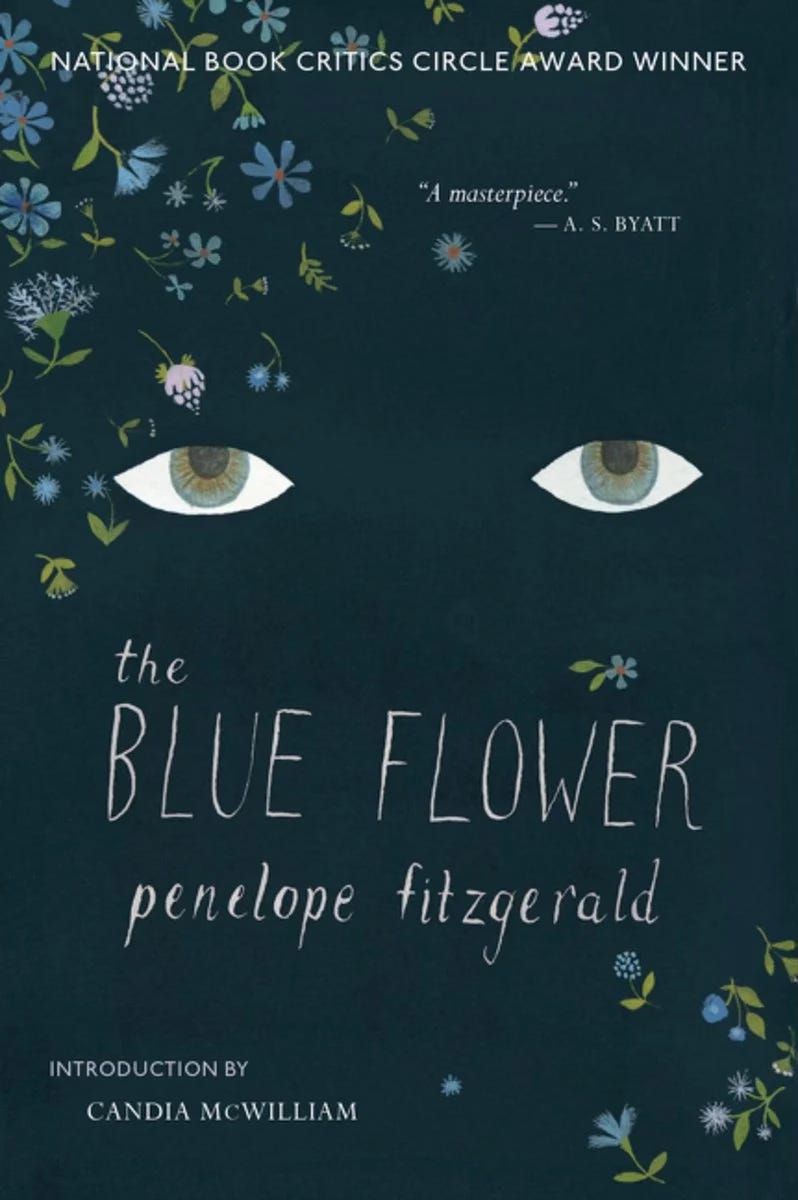
“If a story begins with finding, it must end with searching,” is taken from Penelope Fitzgerald’s The Blue Flower.
The Blue Flower is published by Mariner Books and available from Harper Collins.
Thank you to Ricardo Maldonado and Conscious Writers Collective for prompting me to spend time with the book.
What is your blue flower?
Further adventures and new ways of seeing can be found in my book, The Uses of Art.

Artist Sal Randolph’s THE USES OF ART is a memoir of transformative encounters with works of art, inviting readers into new methods of looking that are both liberating and emboldening.
Dazzlingly original, ferociously intelligent.
— Michael Cunningham
A joyful, dazzling treasure-box of a book.
— Bonnie Friedman
Here’s a guide, to waking up, over and over again.
— Roshi Pat Enkyo O’Hara
Bluebonnets if I’m feeling nostalgic. But cornflowers—I love their simplicity.