

Massive Massive Oil Slick
A letter to my friend Nick in Berlin

Dear Friends,
This is a story about reading, and at the same time it’s a reply to the friend who sent me the book.
I’ve been realizing lately that “reading” isn’t just one thing. It isn’t always, or even most of the time, sitting down and proceeding from page one to the end. I’m always reading an array of books, each in its own way.
I’m late with this letter in part because this book I’ve been reading, Massive Massive Oil Slick by Sean Ashton, acted like a spell, it tangled me up and wouldn’t let go.
— Sal
Dear Nick,
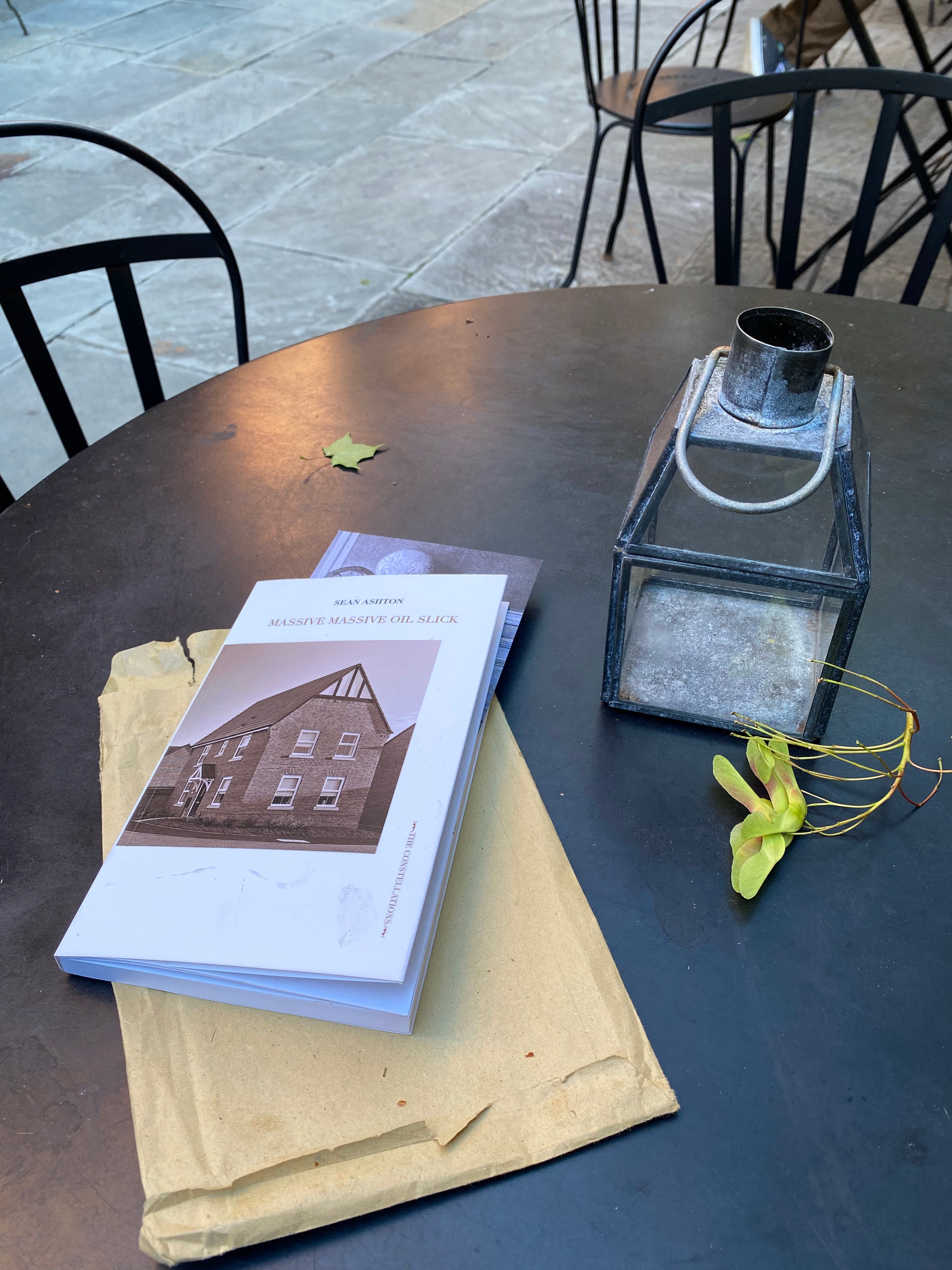
Last weekend, David brought your envelope to me at the book fair. “Sorry,” he said, “I haven’t seen you until now.” From mid-June to Mid-September is a slow postal service, but going from hand to hand is the best way for a package to travel.
The thin brown envelope is perfectly ordinary, but it’s something you would never see in the US. The paper is as light as possible, as if it were from the days when air mail paper was translucent to save postage and it gives off a little of the molecular magic of a German stationary store.
Today is cloudy in New York, neither cool nor warm. I’m writing from the courtyard of a hotel, one which was a seminary when I first lived here. It still has the look, but has been given new occupants. Wind has brought down clusters of winged maple seeds and small leaves from a small tree just overhead. An inchworm drops onto my hand and I blow it off with a puff of breath.
I like being around travelers. They give off a sense of possibility and movement. The feeling reminds me of standing in one of those big European train stations—you could make up your mind to board a train heading in any direction.
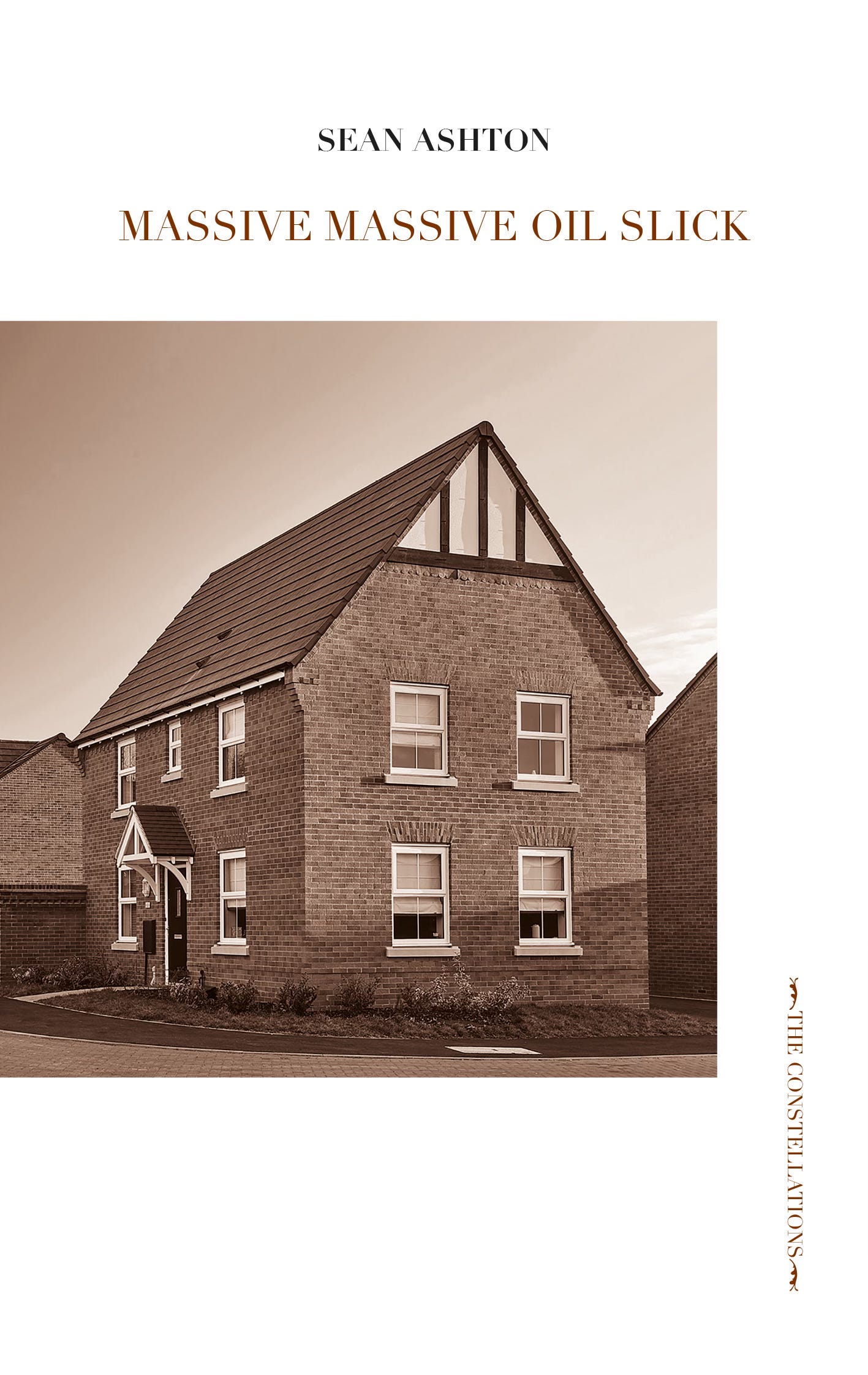
I’m here with the book you sent, Sean Ashton’s Massive Massive Oil Slick, a silky Ma Biblithèque paperback just the size of my hand from palm heel to finger tip. I love that it was conveyed directly from the Miss Read art book fair in Berlin to the New York Art Book fair. Fair to fair, hand to hand.
By now, I imagine you’ve finished the book but I’m still in the early pages.
Moon Snail
I’m reading the book a few pages at a time, the way I often do with books which excite my writerly self. I read while I eat a little something to break my fast, and then, very often, writing begins. It can take me months to finish a book this way, and usually I have a few circulating in my backpack. Today: Massive Massive Oil Slick and Walter Benjamin’s One-Way Street. I pulled Maria Gabriella Llansol’s A Thousand Thoughts in Flight out before I left home because it was heavy and I knew I wouldn’t actually open it this morning. I knew I wouldn’t open the Benjamin either, but it was small, and like Claire-Louise Bennet’s Pond, it’s been something that travels with me so often that its presence in the bag is simply comforting.
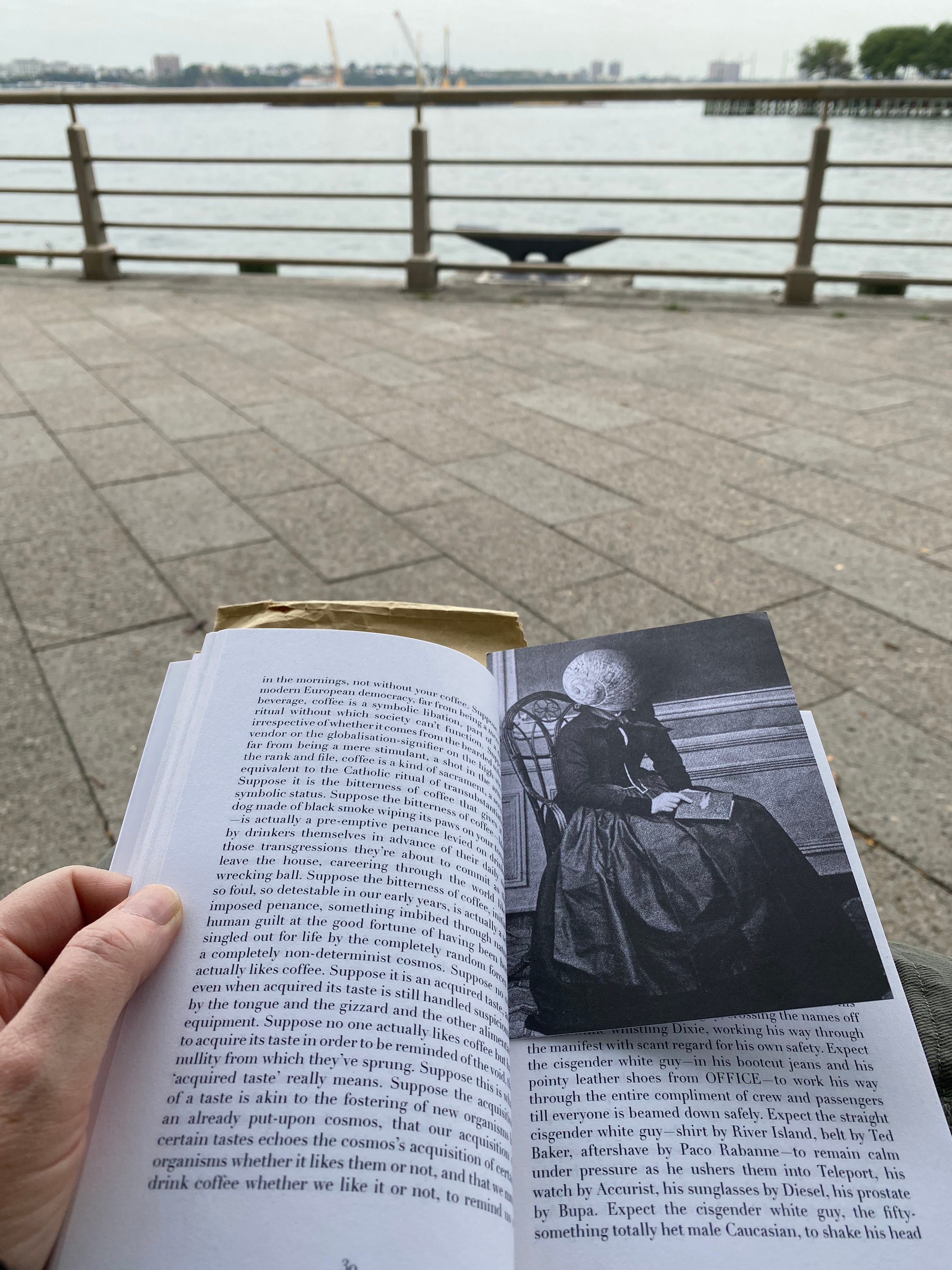
I’m very glad to have your postcard as a bookmark: that grainy black & white image of Victorian woman in a bentwood chair, book in her lap, head replaced by a giant moon snail.
If you go beachcombing in Provincetown, those shells are everywhere. All kinds of people collect them when they first arrive in town, so you’ll see arrangements on shelves and tabletops whenever you visit someone’s house. These moon snails are predators. They attach to another shell, maybe a clam or scallop, drill a perfect round hole like a hole punch in paper, and then consume the helpless dweller. Sometimes they eat each other.
River
I’ve been taking the book on adventures. It’s the next day, and I’m reading by the river. I used to visit the Hudson often, but it’s been a while since I caught that elusive river smell in my nostrils. There are barges with cranes — some kind of dredging operation is going on. The grey of the sky is just a little off from the grey of the water, even though one is a reflection of the other. There are the usual sirens and helicopters plus the growl of the dredgers. I’ve written about this river and filmed it; maybe observing its daily rhythms now is just a way of repeating myself.
My Australian latte tastes like coffee ice cream because I forgot to order a flat white. As it happens, today, I am reading Massive Massive Oil Slick’s section on coffee (pasted below). It’s funny, headlong, ironic, and still I come away, believing that the acquired taste of coffee is central to democracy.
I don’t yet know whether it matters if you read a little of Massive Massive Oil Slick or a lot. I don’t yet know whether there’s something that accumulates or harmonizes or surprises with a special satisfaction when you reach the well-crafted end.
In truth, I prefer books where you can read one page or another, skipping around or reversing direction, so I’m taking this book to be like that, reading in it every day like tasting the weather. Tasting the flavor of thought.
Rapture
At the hotel courtyard again. Everyone’s been saying that today was meant to to be the rapture. I haven’t noticed anyone missing so far, but it’s still morning. What time of day does a rapture come? Midnight seems right, but on the other hand you would expect the rapture to occur in all places simultaneously meaning that it would happen at once across time zones. If you imagine micro-time-zones the rapture would occupy all possible times of the clock even as it happens in a single instant.
Even if the rapture were happening right now, I don’t expect many in New York would be lifted up. Would we see them rising? Floating up into the sky, which today is blue with attractive clouds. If I happen to look down at what I am doing, or maybe I’m just indoors, in my apartment, I might miss it.
Suppose, says Sean Ashton (or his protagonist), the end is no longer ‘nigh.’ In honor of today’s rapture I’m pasting that section below the coffee.
Repetiton and Return
I’m back at the river. The dredgers have moved a little farther down, or have they? They are perfectly still and silent. High tide, and waves push rhythmically against pilings — wakes from boats no longer in sight.
Today is cloudy, humid, warm. The air feels as if something is going to happen. It’s not that there are any revelations: it’s the usual boats, runners, helicopters, sea birds. Motors and sirens, wings, and hulls. The sensation of hovering.
I’ve been thinking about repeating cadences lately and why I’m drawn to them. I’m thinking of chants and laments and spells. I’m thinking of the kaleidoscopic repetitions of the Mahayana sutras, their almost endless listing of bodhisattvas with phantasmagorical aspirational names. Repetition is a kind of magic that makes worlds.
What is the world that Sean Ashton is making? It seems like he’s giving a part of our own world back to us, emphasizing, iterating, exploring. The way he begins each sentence with “suppose” or “expect” or “avoid” transmutes his monologue into something that feels like the media environment of the present in its inevitability and inescapability. Familiar rote phrases are recycled until they reveal their funnier and darker dimensions.
Suppose is like a reality that parallels and investigates our own (“Suppose there is more rain. Suppose there is more snow”). Expect is darker, with a sense of something impending (“Expect delays. Expect major delays and minor delays: three-mile tailbacks, slow-moving traffic.”). Avoid is the spiky voice of negative advice (“Avoid cider. Avoid dry cider and sweet cider.”).
Reading Massive Massive Oil Slick feels like encountering an oracle muttering continuously in the back of a cave. Any time I enter, I find something that speaks to my personal moment, a diagnosis of sorts, maybe a guide. Today it tells me to expect more dictatorship, and naturally I’m feeling it. There’s another “No Kings” march coming up, and you’ll find me in the crowd.
Opening any part of Massive Massive Oil Slick is like returning to a familiar place, a place like the city, like the river. Of course it’s never the same. Of course it’s always the same.
I keep looking at New Jersey across the water and thinking about what it’s like to live in those behind those blocks of windows. New Jersey and New York giving each other the eye. Which is utopia? Which is dystopia? But if you look at the water itself, you feel the way it extends from source to sea. It is the rainfall, It is the ocean.
There is much more to suppose, to expect, and to avoid, but I’ll close here so I can finally send this to you!
Sean Ashton, from Massive Massive Oil Slick
Suppose you can't function. Suppose you're one of these people who just 'can't function' in the mornings until they have had their coffee. Suppose—be it a powerful double-shot flat white from the bearded vendor by the subway or a piss-weak latte from the globalisation-signifier on the high street—you simply 'can't function' in the mornings, not without your coffee. Suppose, in a modern European democracy, far from being a mere hot beverage, coffee is a symbolic libation, part of a daily ritual without which society can't function. suppose, irrespective of whether it comes from the bearded subway vendor or the globalisation-signifier on the high street, far from being a mere stimulant, a shot in the arm for the rank and file, coffee is a kind of sacrament, a secular equivalent to the Catholic ritual of transubstantiation.
Suppose it is the bitterness of coffee that gives it its symbolic status. Suppose the bitterness of coffee-like a dog made of black smoke wiping its paws on your tongue—is actually a pre-emptive penance levied on drinkers by drinkers themselves in advance of their daily sins, those transgressions they're about to commit as they leave the house, careering through the world like a wrecking ball. Suppose the bitterness of coffee, initially so foul, so detestable in our early years, is actually a self imposed penance, something imbibed through natural human guilt at the good fortune of having been born, singled out for life by the completely random forces of a completely non-determinist cosmos. Suppose no one actually likes coffee. Suppose it is an acquired taste, and even when acquired its taste is still handled suspiciously by the tongue and the gizzard and the other alimentary equipment. Suppose no one actually likes coffee but has to acquire its taste in order to be reminded of the void, the nullity from which they've sprung. Suppose this is what 'acquired taste' really means. Suppose the acquisition or a taste is akin to the fostering of new organisms b an already put-upon cosmos, that our acquisition of certain tastes echoes the cosmos's acquisition of certain organisms whether it likes them or not, and that we must drink coffee whether we like it or not, to remind us of the miracle of our advent, the uniqueness of our nativity, the good forbearance of the cosmos in consenting to have us on board, in all our florid imperfection. Suppose there really is this much stake. Suppose there really is this much stake as we stand in line for a strong flat white made to our exacting specifications, or a weak latte from the globalisation-signifier of our choice. Suppose this is the function, the function of coffee in a modern European democracy.
***
Suppose the end is no longer 'nigh'. Suppose the end is no longer nigh', in the old sense. Suppose there are no more broken men willing to proclaim that THE END IS NIGH, no more broken middle-aged men willing to proclaim that THE END IS NIGH on high streets of the United Kingdom. Suppose there shall be no more prophets of doom here in the United Kingdom, this phase of distinctly male despair having now come to a close. Suppose it is passing into history, this humourless eschatology, no more men waking up early knowing exactly what they must do, going out into the shed before breakfast and making a sandwich board from two sheets of ply, almost on autopilot, their tears falling onto the workbench, the last tears they shall ever cry as they retreat thereafter into an emotionless citadel, a personal palace made of cinder. Suppose there is no harm, no harm at all in making such a sandwich board, so long as it's done well, a passable work of graphic art, floral borders, and drop-shadows lending gaiety to its gloomy proposition. A pity, then, that no such sandwich boards are ever likely to be made, still less seen on the high streets of the United Kingdom.
***
Expect to see more dictatorships. Expect to see more dictatorships in formerly democratic states. Expect to see more men feel that they have what it takes to be a strong leader. Expect to see more dictators get what they want. Expect to see a few more dictators get exactly what they want, or what they think they want, in their capacity as men without a superego. Expect eight out of ten dictators to feel basically happy in their work. Expect eighty percent of the dictators and warlords who participated in our survey to admit to occasionally falling short of their objectives without letting it affect their home life; ten percent of dictators and warlords to admit to regularly falling short of their objectives and to be unable to prevent it impacting on their home life; five percent of dictators and warlords to meet all their objectives and to feel proud of their accomplishments; and the remaining five percent of dictators and warlords to exceed all objectives and to feel neither happiness nor regret, only a chilling indifference, their addiction to power only assuaged by increasingly heinous acts of cruelty that leave them unable to feel any emotion at all, even towards their own family.
Sean Ashton
Sean Ashton’s Massive Massive Oil Slick is available from Ma Bibliothèque (for shipping outside the UK, order from the distributor, Art Data).
You can hear Sean Ashton reading an excerpt here.
Sean Ashton talks about the writing of Massive Massive Oil Slick here.
Or in case you wish this letter was a proper review, there’s a pretty great review of Massive Massive Oil Slick by Michael Hampton in Exacting Clam.
Dana Engfer
Update!
Thanks to Nick, we now know more about the artist who made the image on the postcard, Dana Engfer. The image is part of a larger project involving snails and their shells: Schneckenhaus-Sammlung.
Follow Dana Engfer on Instagram.
Dear Reader, this letter is also a letter to you. Write back! What are you reading and how and where?
Further adventures and new ways of seeing can be found in my book, The Uses of Art.

Artist Sal Randolph’s THE USES OF ART is a memoir of transformative encounters with works of art, inviting readers into new methods of looking that are both liberating and emboldening.
Dazzlingly original, ferociously intelligent.
— Michael Cunningham
A joyful, dazzling treasure-box of a book.
— Bonnie Friedman
Here’s a guide, to waking up, over and over again.
— Roshi Pat Enkyo O’Hara
While I don’t know if I’m up for an oracle muttering in the back of a cave, I enjoyed the freshness of the image and this piece.
https://www.instagram.com/dana_engfer/p/DNlYfIkINcS/
followed your link to her insta: this post explains exactly how the snail images on the postcards came about ...