

Lightning Ragini
Writing from the season of storms.

Dear Friends,
I’ve been in some spectacular storms recently. Have you?
— Sal
Lightning Ragini
The use of force is prohibited in building rivers, which should leave you unknowing. I was an animal, you were an animal, but we found ourselves in opposition, the river like a gown between us. I combed the waters with petals, as if performing an enfleurage or inflowering, but you, my once-beloved, displayed nothing but indifference, the way a comet does as it waves goodbye to the sun, imagining it will never return.
Where I thought there would be nobody, there was merely nothing. Even of zeros, there were none. In that absence I foresaw an amplitude, capacious in its opulence. It looked like opals, an opaline no-one, an iridescing nil that expressed the nowhere of all that I remembered: animals, orchids, stones, ants, clouds.
The rain was late in coming, and I longed for its hail and flood. I would eat only lightning in that future, I would sleep on pillows of thunder. A torrent would be the river between us, turning from one river into many. Rivers. Did you think you remembered mountains? No, even the oceans were nothing in the face of my wishing. Breezes will become winds, aquifers will fill and I promise you nothing but grass. Cedars will fall. Magic will fill the air like snow or ash. Again, and again the iridescence of your constant flashing.

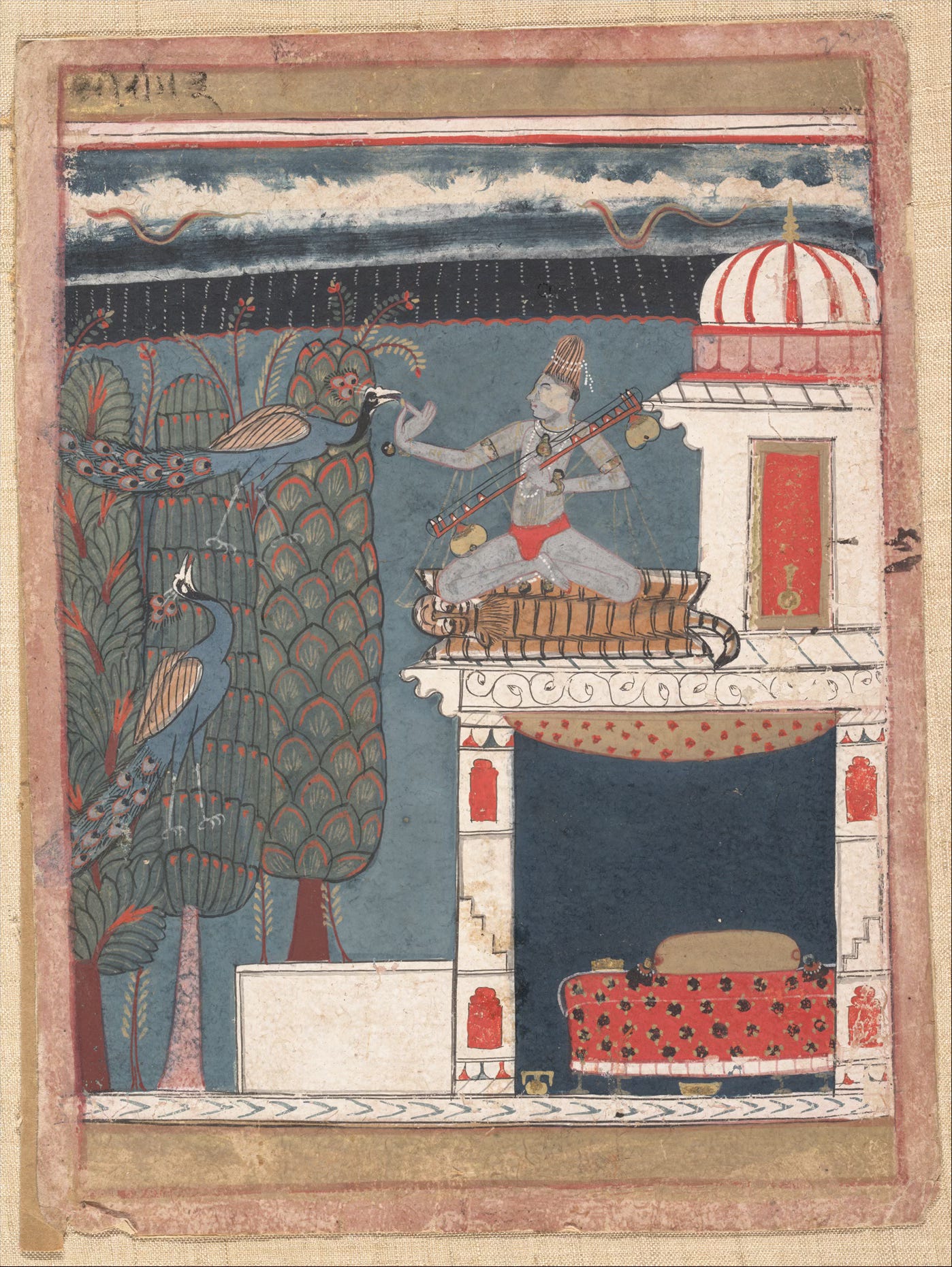
Setmalar Ragini
From the Metropolitan Museum:
This ragini evokes the rainy season and is given dramatic expression by the bands of heavy clouds and snakelike bolts of lightning across the upper register. The associated text by Lachiman Das tells of a woman, who, stricken by separation from her husband, has dressed as a man and taken up asceticism: “[She] has rubbed ash on her body . . .[and] remembers, in her heart, [her] husband . . . [as she sits] in the courtyard of the hermitage. The dark clouds appeared from the four directions, followed by the birds and brilliant lightning.” The juxtaposition of flattened forms and color fields, which are typical of the Malwa painting style that flourished outside the Mughal sphere of influence, gives this work a forceful presence.
Friend, this letter is a letter to you. I love nothing more than hearing your responses and free associations.
Further adventures and new ways of seeing can be found in my book, The Uses of Art.

Artist Sal Randolph’s THE USES OF ART is a memoir of transformative encounters with works of art, inviting readers into new methods of looking that are both liberating and emboldening.
Dazzlingly original, ferociously intelligent.
— Michael Cunningham
A joyful, dazzling treasure-box of a book.
— Bonnie Friedman
Here’s a guide, to waking up, over and over again.
— Roshi Pat Enkyo O’Hara
Decades ago, after spending time in India, I wrote this raga poem which I thought I might append here for those who wander into the comments.
Civilization
The human ability to play a raga on the sitar, a molecular architecture on the wind. When the rains finally came, drumming from the sky, our driver hit on us, asked us home, thinking perhaps of our breasts under the thin, soaked cotton we wore. I lay on the bed sick with Mozart in the headphones. The human ability to be subtle or complex, and the architecture of thought which sustains it. Intricate monument of sound we walk through, cool inside, tourists out of the heat. High wind on the curtains behind the players. After the long silence of waiting it comes quickly, faster and faster til we are dancing, howling, slapping our feet on the stones. Such echoes, like applause.
Extra sweet. 🔥 I was only going to glance at it, honestly — but it wouldn't let me go. How often does •that• happen?